


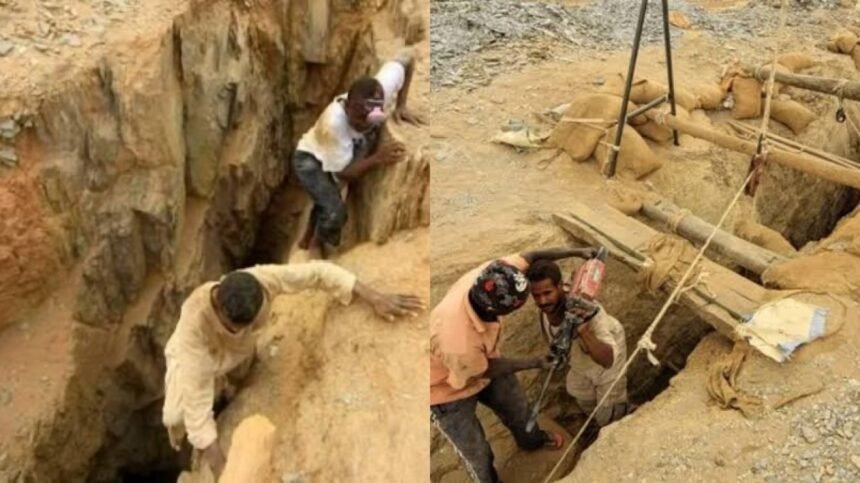
At least 82 people have died and dozens more remain missing following a catastrophic gold mine collapse in Sudan's West Kordofan province. The disaster struck the Al-Zara gold mine in Nuhud on Wednesday afternoon, igniting a desperate search for survivors in a context marked by conflict and inadequate infrastructure.
The collapse began in a single mine shaft before rapidly spreading to interconnected shafts. Suleiman Abu Hmeida, a member of the Emergency Response Rooms, confirmed that rescuers pulled out eighty-two bodies by Wednesday afternoon, adding that a dozen remain unaccounted for.
Khairal-Sayed Gabara, who described the situation, said, "The collapse is massive and the situation is very dire," explaining that machinery needed to remove the collapsed soil and rubble was not available. He highlighted the extreme depths at which workers were trapped, stating, "Workers do not have the machinery to lift dirt and stones and search for survivors at depths of more than thirty meters, or ninety-eight feet, where dozens of people were working."
The search efforts are severely hampered by a lack of equipment. Local officials report that only one privately owned forklift is available to assist in the excavation work. As of Wednesday morning, Al-Amin Suliman reported that sixty bodies had been recovered, while warning that people remain stuck inside the mine.
The Sudan Doctors Network criticized the site for its total absence of basic safety and protective measures, predicting that the death toll will likely climb further. This disaster highlights the perilous conditions under which many miners operate in Sudan, where safety regulations are rarely enforced.
The Al-Zara gold mine is located in a region controlled by the paramilitary Rapid Support Forces (RSF). Fighting between the RSF and the Sudanese military has escalated over the past three years, leading to significant strain on local resources and emergency response capabilities. The Kordofan Observatory notes that the site stretches over one kilometre across fragile, sandy soil, making the underground network exceptionally unstable.


Gold mining in Sudan has often been characterized by a lack of oversight. Past incidents include a collapse in 2023 that killed fourteen miners and another disaster in 2021 that claimed thirty-eight lives. Despite these dangers, thousands of small-scale and informal mines continue to operate across the country, which serves as a vital economic lifeline.
The ongoing civil war has further complicated matters. Large quantities of gold have reportedly been smuggled out of the country to finance the RSF, which controls key gold-producing territories in Darfur and Kordofan. The conflict began in April 2023, with open warfare erupting between the RSF and the Sudanese military. Monitoring groups estimate that the war has claimed at least fifty-nine thousand lives, a figure likely much higher due to underreporting in a nation experiencing famine conditions.
As rescue operations continue, the situation at the Al-Zara mine reveals the systemic instability that exacerbates the dangers faced by civilian populations caught in prolonged conflict. The lack of basic safety measures and the failure to enforce regulations create an environment where tragedies like this can occur with alarming frequency. This incident serves as a stark reminder of the human cost behind the pursuit of precious resources in war-torn regions.
According to Joy Online.